

More information on the options
- Our community told us in the ‘60 seconds for Selwyn’ survey they support this option from the start, with 34% of the 6,900 responses wanting us to explore Selwyn becoming a unitary authority.
- Strong local voice and identity are maintained, including rural communities.
- Lowest transition costs and least disruption to existing services.
- Assets, debt and revenue would remain with Selwyn unless specifically transferred.
- Local priorities and budgets would continue to be determined by Selwyn.
- Decisions on how we manage growth stay with Selwyn, without competing priorities from other districts.
- Selwyn will need to bring in some skills and expertise to deliver some of the functions Environment Canterbury currently provides.
- Selwyn would need to rely more on agreements with other unitary councils to deliver some regional functions, perhaps things like public transport or river catchment management.
- This option depends on Selwyn partnering with another council to submit our proposal. Without putting our proposal together with another council’s proposal, this option won't meet Head Start requirements.
Option 1: Selwyn Unitary Authority
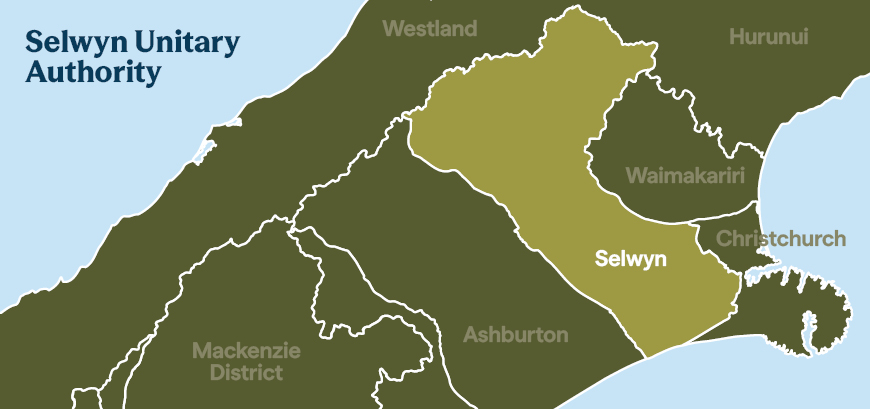
Selwyn District becomes a unitary authority. This means in addition to district council functions (e.g. roading and water) Selwyn would also be responsible for some regional functions in the area. This option would require Selwyn to work with other unitary councils to perform all regional functions currently managed by Environment Canterbury.
What works in its favour
Challenges and risks
Option 2: Mid Canterbury Unitary Authority (Selwyn & Ashburton)
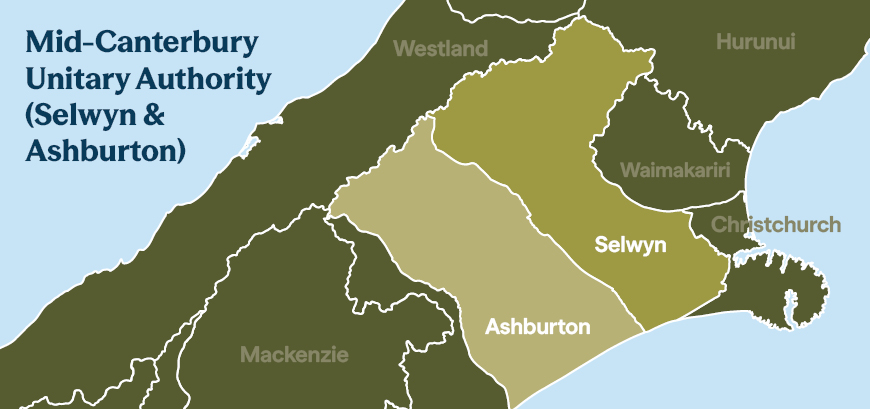
Selwyn and Ashburton districts combine to form a single unitary authority, taking on some of Environment Canterbury's current functions across both areas. This option would require the new council to work with other unitary councils to perform some regional functions currently managed by Environment Canterbury.
What works in its favour
• Selwyn and Ashburton stay whole.
• District and regional functions would sit within one organisation across both districts.
• Rural communities maintain a high level of representation.
• Selwyn and Ashburton share similar rural and economic interests, which may mean decisions and investments are aligned.
Challenges and risks
• Local representation would need to reflect both districts.
• The cost of merging the two councils into one unitary authority is not yet known.
• Existing policies, systems and processes across both councils would need to be standardised, which will take time and resource.
• Selwyn and Ashburton would need to rely more on agreements with other unitary councils to deliver some regional functions, perhaps things like public transport or river catchment management.
Option 3: Selwyn, Christchurch, Waimakariri & Hurunui Unitary Authority
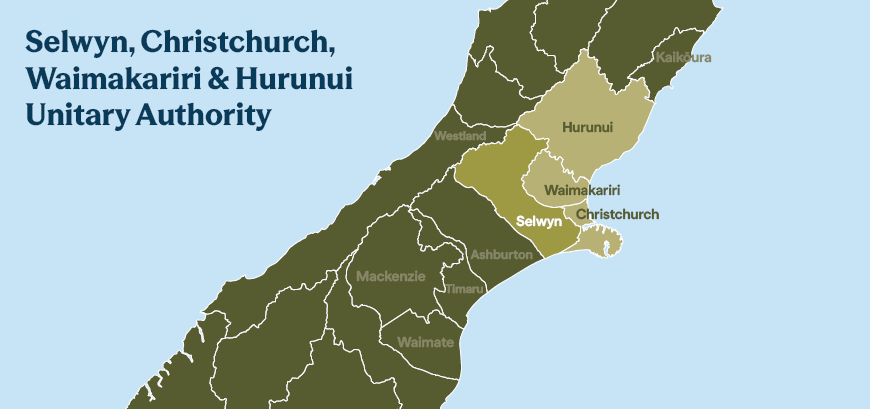
A unitary authority bringing together Selwyn, Christchurch, Waimakariri and Hurunui into one central unitary authority. This option may require the new unitary to work with other unitary councils to perform all regional functions currently managed by Environment Canterbury.
What works in its favour
• No district or rural area is split between different authorities. Selwyn, Christchurch, Waimakariri and Hurunui, stay whole.
• Christchurch, Selwyn and Waimakariri are all growing at a similar rate, so the focus on things like infrastructure and housing might be similar.
• One organisation would be responsible for local and regional functions across the four districts, which supports planning across the area including the shared Waimakariri River catchment.
Challenges and risks
• Representation arrangements would need to ensure local communities continue to have a voice; community or local boards may require delegated decision-making and budget.
• Existing assets, debt and liabilities would need to be combined.
• Growth management may be challenging amid competing priorities across the four districts.
• Combining four district councils will be complex. Existing policies, systems and processes across all councils would need to be standardised, which will take time and resource.