

Draft Waste Management and Minimisation Plan Consultation
Your waste. Selwyn’s future. Have your say.
Selwyn District Council is seeking community feedback on its Draft Waste Management and Minimisation Plan (WMMP).
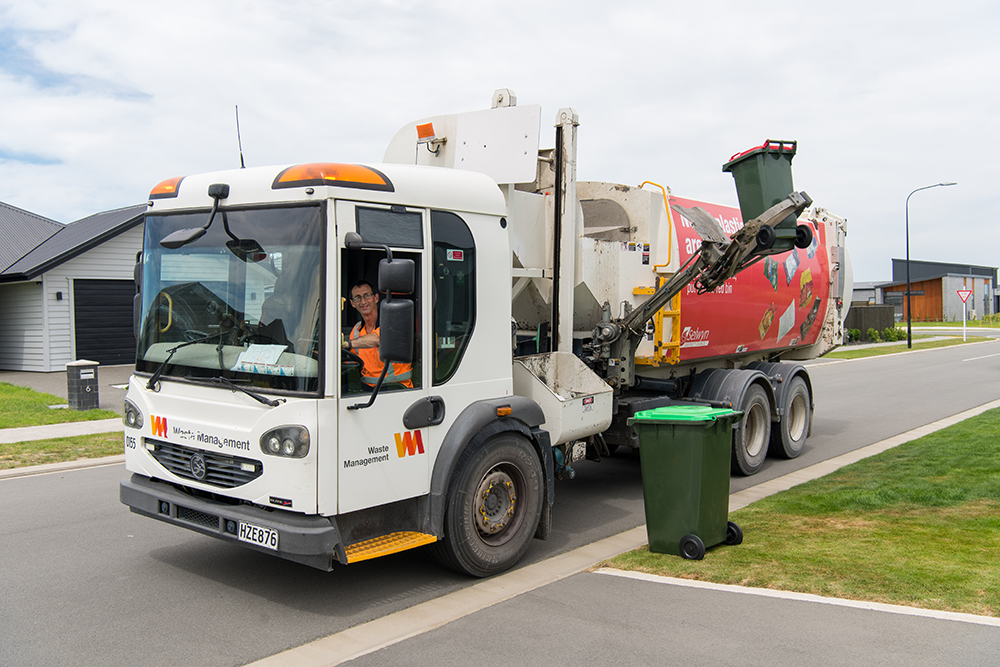
As Selwyn grows, so does the amount of waste we produce. This puts pressure on landfill and increases costs for our community.
On average, 55% of what goes into Selwyn's red bins is food waste, garden waste, or recyclable materials that could be diverted from landfill. When food and garden waste is buried in landfill, it breaks down and produces greenhouse gases, while valuable nutrients that could enrich our soils are lost.
Selwyn households currently throw away enough waste to fill around 2000 buses every year.
Nearly half of this waste is organic material that could be composted or collected separately. Analysis shows that if every Selwyn household composted at home or used a green bin for food and garden waste instead of putting it in the red bin, the emissions savings would be equivalent to driving from Rolleston to Auckland and back nearly 10,000 times every year.
By reducing waste and making better use of food scraps, garden waste, and recyclables, we can help keep costs down, reduce greenhouse gas emissions, and create a more sustainable future for Selwyn.
What is the Waste Management and Minimisation Plan?
The Waste Management and Minimisation Plan sets the strategic direction for how waste will be reduced, reused, recycled, and managed across the district for the next six years. It sets clear goals and actions to reduce the amount of waste sent to landfill and improve resource recovery.
Our Vision
Selwyn District leads by example, embracing the Waste Hierarchy to its fullest potential, wherever practical and affordable, to make the most of our resources, champion a thriving circular economy, reduce consumption, and minimise waste, all while fostering a cleaner, healthier environment for current and future generations.
Consultation Overview
Selwyn District Council is undertaking a consultation on its Draft Waste Management and Minimisation Plan (WMMP).
Through this consultation, we want to:
- Raise awareness of the waste challenges facing our district.
- Share the options being considered to reduce landfill waste.
- Understand community views on proposed waste and recycling service changes, and
- Help shape the priorities and actions that will guide waste management in Selwyn for years to come.
For further explanation please refer to our Consultation Document.
Any significant changes resulting from this consultation would not take effect until 1 July 2029, allowing time for detailed planning, infrastructure development, and community preparation.
What we would like to know
In the Draft Waste Management and Minimisation Plan Consultation we are seeking feedback on our current kerbside collection and two alternatives.
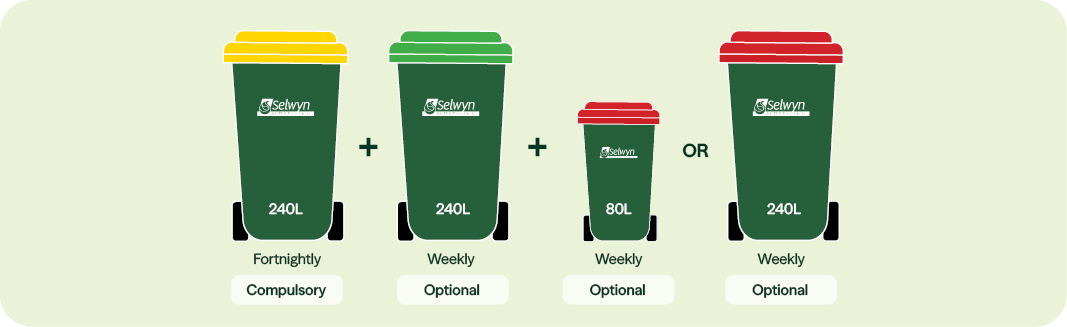
Option A: Current kerbside collection
- Compulsory yellow (recycling) bin
- Optional red (rubbish) bin or bag***
- Optional green (organics) bin. Available in Darfield, Doyleston, Kirwee, Leeston, Lincoln, Prebbleton, Rolleston, Southbridge, Springston, Tai Tapu, and West Melton.
Option B: Proposed 3-bin kerbside collection
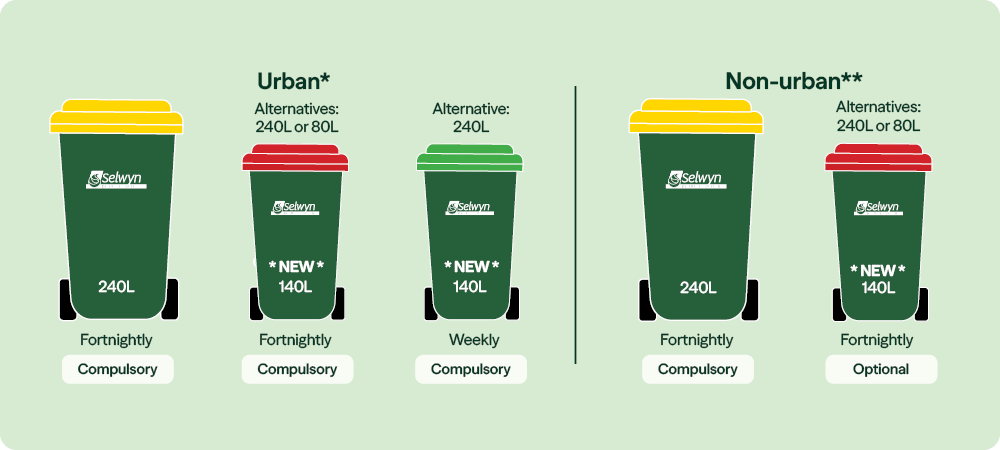
- Green (organics), red (rubbish) and yellow (recycling) bins are compulsory in urban* areas
- Red (rubbish) bin collection changes to fortnightly everywhere and available in multiple sizes
- Red bin costs would reduce
Option C: Proposed fortnightly rubbish kerbside collection
- Keep green (organics) bin as optional in urban* areas
- Keep red (rubbish) bin optional, but make them fortnightly everywhere, and available in multiple sizes
- Keep yellow (recycling) bin compulsory
- Red bin costs would reduce
Urban: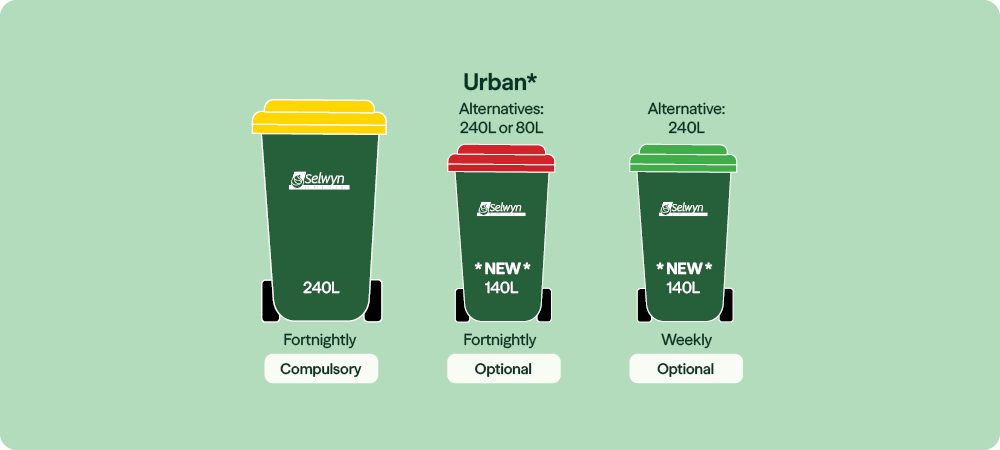
Non-urban (Rural):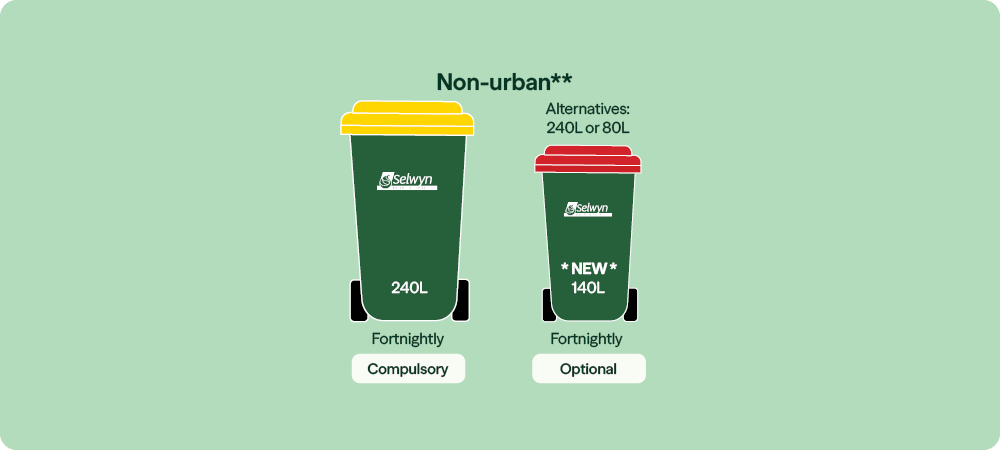
*Urban areas are defined as townships with a population of more than 1000. In Selwyn this is Darfield, Kirwee, Leeston, Lincoln, Prebbleton, Rolleston, Southbridge, West Melton.
** Non-urban (rural) areas that currently receive the organics service will continue to have this.
*** Rubbish bag option will remain available.
Costs for kerbside bin options
Option A: Current kerbside collection
If the current kerbside collection system is retained with no changes, costs could increase more quickly than the two alternative proposals.
This is because:
• Keeping red bin collections weekly means greater exposure to future fuel and labour cost increases.
• Continuing to send food and garden waste to landfill means greater exposure to future landfill disposal
Option B: Proposed 3-bin kerbside collection
Urban households (compulsory organics bin)
• 82% of households would have an estimated cost reduction of $10–$72 per year
• 16% of households would have an estimated cost increase of $106–$155 per year
• 3% of households (that have recycling bins only) could have an estimated cost increase of $284 per year. Note that these households may be paying a private collector or using rubbish bags.
Non-urban (rural) households (optional organics bin where available)
• All non-urban (rural) households would have an estimated cost reduction of $10–$59 per year
Option C: Proposed fortnightly rubbish bin kerbside collection
• All households (urban and non-urban (rural)) would have an estimated cost reduction of $10–$72 per year
To view all pricing, click here.
Have your say
We want to hear your views on our current waste services and the options being considered for future kerbside collections from 1 July 2029. Our survey should take no longer than 10 minutes to complete.
Your feedback will help Council understand:
- Your preferred option.
- Any barriers or challenges associated with each option.
- Practical considerations for households and the wider community.
- Your thoughts on other actions within the Draft Waste Management and Minimisation Plan
The feedback received through this consultation will help inform the future direction of waste and recycling services and support the goals of the Draft Waste Management and Minimisation Plan.
We have two surveys – one for urban residents in Darfield, Kirwee, Leeston, Lincoln, Prebbleton, Rolleston, Southbridge and West Melton, the other for all of our non-urban (rural) residents.
Complete the non-urban (rural) survey
Your feedback is important and will help shape Selwyn's waste future.